Look, if you’re trying to figure out which printing technology to invest in, you’re not alone. I see this question constantly. DTF or DTG? And honestly, the answer isn’t as simple as most guides make it seem.
Both technologies have completely changed how we print on garments. That’s not an exaggeration. But here’s the thing—they’re not interchangeable. They serve different purposes. Different business models. Different customers. Choosing the wrong one can cost you thousands. Choosing the right one can change your entire operation.
This guide is going to break down everything. Print quality, costs, fabric compatibility, durability—all of it. I’ll tell you what actually matters and what’s just marketing fluff. By the end, you’ll know exactly which technology fits your situation. Maybe it’s DTF. Maybe it’s DTG. Maybe it’s both. Let’s figure it out.
What is DTF Printing?
DTF stands for Direct-to-Film. And yeah, the name basically explains it. You print your design onto a special film, then transfer that design onto fabric using heat. Simple concept. But the execution is what makes it interesting.
DTF hit the market around 2017-2018, but it really exploded in 2020. The pandemic pushed a lot of people into custom printing, and DTF was accessible. Affordable. Forgiving. It didn’t require the same learning curve as other methods. Print shops that had been struggling with DTG suddenly found their groove with DTF.
Why did it catch on so fast? Versatility. You can print on basically anything. Cotton, polyester, blends, leather, nylon—doesn’t matter. No pre-treatment. No fabric restrictions. That flexibility is a game-changer for businesses serving diverse markets.
How Does DTF Printing Work?
The process has five main steps. Each one matters.
Step 1: Design Preparation. You set up your artwork in your RIP software. Nothing special here—standard design preparation. Make sure your colors are right, your resolution is solid.
Step 2: Printing on PET Film. Your DTF printer lays down the design on a special polyester film. The printer uses CMYK inks plus white ink. The white goes down first or last depending on your setup—this creates the base that makes colors pop, especially on dark garments.
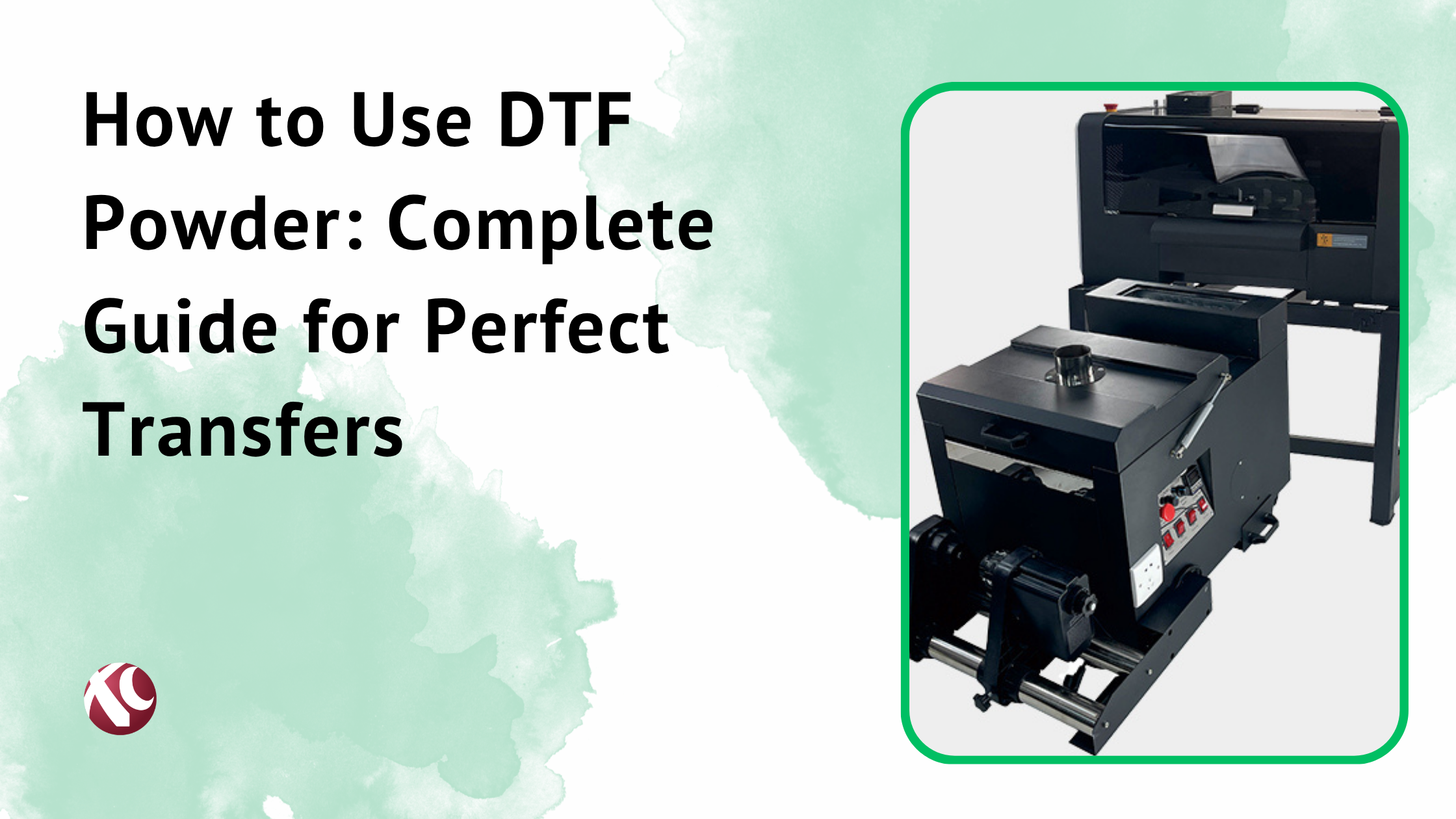
Step 3: Applying Adhesive Powder. Right after printing, you apply TPU powder (thermoplastic polyurethane) to the wet ink. The powder only sticks where there’s ink. Some people use a powder shaker machine, others do it manually. Machines are more consistent.
Step 4: Curing the Powder. You melt that powder using heat. This can happen in a curing oven, with a heat press, or with a specialized curing unit. The powder melts and bonds with the ink. Now you’ve got a transfer that’s ready to use—or ready to store.
Step 5: Heat Pressing onto Garment. Place your cured transfer on the fabric, hit it with the heat press (typically 300-320°F for 10-15 seconds), peel the film, and you’re done. Some transfers are hot peel, some are cold peel. Depends on your film.
Equipment you’ll need: DTF printer, powder shaker (or manual setup), curing oven or heat press for curing, heat press for transfer application.
Key Features of DTF Technology
Here’s what makes DTF stand out:
- Works on almost any fabric. Cotton, polyester, blends, leather, nylon, denim, canvas. Seriously versatile.
- No pre-treatment required. This saves time and eliminates a major variable.
- Vibrant color output. Colors really pop, especially on dark garments.
- White ink capability. Essential for dark fabrics—creates that opaque base.
- Soft hand feel. Not as soft as DTG, but definitely comfortable. Not plasticky like old-school transfers.
- Stretchability. The transfer flexes with the fabric. No cracking.
- Durability. These prints last. 50+ washes is normal with proper application.
What is DTG Printing?
DTG stands for Direct-to-Garment. Think of it like an inkjet printer, but for fabric. Your design goes straight from computer to garment. No film, no transfer, no intermediate step.
DTG has been around longer than DTF. It became mainstream in the mid-2000s, with brands like Kornit and Brother leading the charge. For years, it was the technology for custom apparel. Print-on-demand businesses were built on DTG. Still are, in many cases.
The appeal was obvious. You could print one shirt at a time without setup costs. Full-color, photographic quality. Complex designs with unlimited colors. It democratized custom printing in a way screen printing never could.
How Does DTG Printing Work?
DTG has its own multi-step process:
Step 1: Design Preparation and Color Management. This matters more with DTG than DTF. You need good color profiles, proper file setup. DTG is picky about color accuracy, so spending time here pays off.
Step 2: Pre-treatment (for dark fabrics). It’s essential. Skip it and your prints will look washed out or won’t stick at all. Light fabrics sometimes skip this step, but I recommend it anyway for consistency.
Step 3: Loading the Garment. You place the shirt on a flat platen. Has to be smooth, no wrinkles. The printer needs a flat surface.
Step 4: Direct Printing. The printer sprays water-based ink directly onto the fabric. White ink goes down first (on dark fabrics), then CMYK colors on top. The ink actually absorbs into the fibers.
Step 5: Curing. After printing, you cure the garment with a heat press. Usually 30-60 seconds at around 330°F.
Equipment needed: DTG printer, pre-treatment machine (or manual spray), heat press.
Key Features of DTG Technology
What makes DTG unique:
- Best on cotton and cotton blends. Cotton is where DTG shines.
- Requires fabric pre-treatment. Especially for dark garments. It’s an extra step that takes time.
- Photographic quality prints possible. Seriously impressive detail. Gradients, fine lines, complex artwork—DTG handles it.
- No minimum order quantity. One shirt? Sure. Ten thousand? Also fine. But really optimized for small batches.
- Ideal for complex designs. Unlimited colors, no separation needed, great for photo prints.
- Eco-friendly water-based inks. These inks are better for the environment than many alternatives.
DTF vs DTG: Head-to-Head Comparison

Alright, this is the section that matters most. I’m going to compare these technologies across every factor that actually affects your decision. Not just the specs—the real-world implications.
Understanding these differences helps you choose the right technology. Or helps you understand if you need both. Let’s go through it.
1. Print Quality and Detail
Both produce professional-quality prints. But they look and feel different.
DTF gives you vibrant colors with excellent opacity. The white ink base means colors pop on any fabric, including dark ones. You get great color vibrancy across all materials. The prints have a slightly thicker feel—not bad, just noticeable. Some people actually prefer it.
DTG produces photo-realistic quality that’s hard to beat on the right fabrics. The hand feel is softer because the ink absorbs into the fibers rather than sitting on top. For intricate details on light cotton? DTG wins. But on dark fabrics or synthetics, it can struggle.
Resolution capabilities are similar—both can handle high-detail designs. But color accuracy on difficult fabrics goes to DTF. On premium cotton with perfect conditions? DTG edges ahead for photographic work.
Here’s the honest truth: most customers can’t tell the difference. Seriously. But if you’re targeting designers or fashion-forward brands who care about hand feel, that matters.
2. Fabric Compatibility
This is where DTF pulls way ahead.
DTF works on:
- Cotton
- Polyester
- Cotton/poly blends
- Leather
- Nylon
- Denim
- Canvas
- Synthetic materials
- Basically anything you can heat press
No fabric restrictions. That’s huge.
DTG works best on:
- 100% cotton
- High cotton blends (minimum 50% cotton recommended)
- Ringspun cotton performs best
DTG struggles with:
- 100% polyester (dye migration issues)
- Low cotton blends
- Performance fabrics
- Synthetics in general
Why the difference? DTG inks absorb into natural fibers. Synthetic fibers don’t absorb the same way, plus polyester has dye migration problems at high temperatures. The dyes in the fabric can bleed into your print. Not good.
If your business prints primarily on cotton tees, this limitation might not matter. But if you want to offer hoodies in poly blends, performance wear, or diverse product options—DTF is the answer.
3. Production Speed and Workflow
Production speed depends heavily on your order type.
DTF workflow: You can pre-print transfers in bulk. Print 100 transfers today, apply them whenever. The actual transfer application takes 10-15 seconds per garment. For large orders, this is incredibly efficient. You can also print during slow periods and build inventory.
DTG workflow: Everything happens in sequence. Pre-treat, load, print, cure. Each step takes time. A single dark shirt might take 5-7 minutes total. Light shirts are faster since you skip pre-treatment, but you’re still printing one-by-one.
For small orders (1-10 pieces), DTG can actually be faster because there’s no transfer preparation.
For bulk orders (50+ pieces), DTF dominates. It’s not even close.
The ability to pre-produce transfers changes your business model. You can batch similar work, print during downtime, and fulfill orders faster.
4. Initial Investment and Setup Costs
Let’s talk money. Real numbers.
DTF Setup:
- Entry-level DTF printer: $2,000-$5,000
- Mid-range DTF printer: $5,000-$15,000
- Commercial DTF printer: $15,000-$40,000+
- Powder shaker: $300-$2,000
- Curing oven: $500-$3,000
- Heat press: $300-$1,500
Total entry-level startup: Around $3,500-$8,000
DTG Setup:
- Entry-level DTG printer: $10,000-$20,000
- Mid-range DTG printer: $20,000-$50,000
- Commercial DTG printer: $50,000-$200,000+
- Pre-treatment machine: $500-$3,000
- Heat press: $300-$1,500
Total entry-level startup: Around $12,000-$25,000
DTF has a significantly lower barrier to entry. That’s why so many small businesses and side hustlers have jumped in. You can start a legitimate print business for under $5,000.
DTG requires more capital upfront. The printers themselves are more expensive, and there’s less budget options in the market. You’re making a bigger commitment.
5. Operating Costs and Consumables
Initial investment is one thing. But operating costs affect your margins forever.
DTF ongoing costs:
- Ink: Moderate cost, similar to DTG
- PET film: $0.10-$0.30 per transfer (varies by size)
- Adhesive powder: $20-$50 per kilogram (goes a long way)
- Estimated cost per print: $0.50-$2.00 depending on size
DTG ongoing costs:
- Ink: Generally higher than DTF, especially white ink
- Pre-treatment solution: $0.10-$0.25 per garment
- Maintenance: Frequent cleaning cycles use ink
- Estimated cost per print: $1.00-$4.00 depending on design coverage
DTG white ink consumption is the killer. It’s expensive and you use a lot of it, especially on dark garments. Plus DTG printers run cleaning cycles that consume ink even when you’re not printing. Leave a DTG printer sitting for a week and it’ll do multiple cleaning cycles just to keep the heads from clogging.
For high-volume production, DTF is more economical. For very low volume with mostly light garments, the difference shrinks.
6. Durability and Wash Resistance
How long do the prints last? This matters to your customers.
DTF durability:
- 50+ washes with proper application
- Colors maintain vibrancy well
- Resistant to cracking
- Stretches with fabric
- Proper curing is essential
DTG durability:
- 30-50 washes typically
- May fade over time, especially bright colors
- Softer feel means less “presence” after washing
- Requires proper curing temperature and time
Both last well with proper technique. But DTF generally holds up longer, especially the color vibrancy. I’ve seen DTF prints after 80+ washes still looking solid. DTG prints tend to soften and fade more noticeably.
Factors that kill durability for both: under-curing, improper heat press temperature, wrong fabric, customer not following care instructions.
7. Learning Curve and Ease of Use
If you’re new to garment printing, this matters a lot.
DTF learning curve:
- Relatively easy to learn
- Fewer variables to control
- More forgiving of mistakes
- Results are consistent once you nail the process
- Maintenance is straightforward
Most people can produce good DTF prints within days of getting their equipment. The process is linear and the variables are limited.
DTG learning curve:
- Steeper learning curve
- Pre-treatment application is tricky (too much, too little, uneven—all cause problems)
- Humidity affects print quality
- Color management requires attention
- More troubleshooting needed
- Maintenance is more demanding
DTG requires more skill. You need to understand pre-treatment coverage, fabric moisture levels, environment control. Some DTG operators spend weeks or months getting consistent results.
If you’re training staff, DTF is easier. If you’re doing everything yourself and learning, DTF lets you get to production faster.
8. Versatility and Application Range
What can you actually print on?
DTF applications:
- All garment types
- Bags and totes
- Shoes
- Hats
- Leather goods
- Some hard surfaces (with modifications)
- Promotional products
- Home textiles
DTF opens doors because the transfer can go on almost anything that tolerates heat pressing.
DTG applications:
- T-shirts
- Hoodies (cotton)
- Cotton apparel in general
- Limited to fabric applications
- Best for fashion and custom apparel
DTG is really a garment-only technology. And within garments, mainly cotton garments.
If you want to offer diverse products—expand beyond just t-shirts—DTF gives you more business opportunities. You can print transfers for hats, bags, even specialty items. That diversification can be the difference between surviving slow seasons and thriving.
9. Environmental Impact
This matters more every year. Customers ask about it.
DTF environmental considerations:
- Uses plastisol-like process
- Powder waste is possible (overspray, cleanup)
- Chemical adhesives involved
- PET film is plastic (recyclability varies)
- Energy consumption for curing
DTF isn’t the most eco-friendly option. The adhesive powder and film create some waste, and the chemicals involved aren’t exactly green.
DTG environmental considerations:
- Water-based inks
- More eco-friendly overall
- Less physical waste
- GOTS certification possible for some setups
- Lower chemical footprint
If you’re targeting environmentally conscious customers or seeking certifications, DTG is the better choice. Some DTG setups can be part of GOTS-certified production chains for organic garments. DTF can’t make that claim.
Honestly though? Neither technology is terrible for the environment. Both are better than traditional screen printing with plastisol inks in many respects. But if eco-credentials matter to your brand, DTG wins this one.
10. Minimum Order Requirements
How does each technology handle different order sizes?
DTF order flexibility:
- Efficient for single pieces AND bulk orders
- Can pre-print transfers and store them
- Gang sheets allow multiple designs on one print
- Scales up beautifully
- Scales down just fine too
DTG order flexibility:
- Ideal for one-off prints
- Perfect for small batches
- Print-on-demand friendly
- No inventory needed
- Less efficient for bulk
Both handle small orders. But DTF handles both extremes better. Print one? Fine. Print a thousand? Also fine, and you’ll do it efficiently.
DTG is optimized for the one-to-twenty piece range. That’s the sweet spot. Beyond that, efficiency drops compared to DTF.
For print-on-demand businesses where every order is different, DTG’s direct workflow makes sense—no transfers to manage. But if you’re doing fulfillment with any repeat designs, DTF’s batch capability wins.
Advantages of DTF Printing

Let me lay out why DTF has taken off:
Superior fabric versatility. This is the big one. Cotton, polyester, blends, leather, nylon—it doesn’t matter. One technology, endless substrates.
No pre-treatment needed. Skip an entire step. Save time. Eliminate a variable that causes problems.
Excellent color vibrancy on dark fabrics. The white ink base means colors pop the same way on black as they do on white. Consistent results across garment colors.
Better performance on polyester and blends. DTG can’t touch poly. DTF doesn’t care.
Bulk production capability. Print hundreds of transfers, store them, apply them whenever. Build inventory during slow periods.
Lower cost per print at volume. Once you’re producing consistently, DTF is cheaper per piece than DTG for most applications.
Strong durability. These prints last. 50+ washes, maintained vibrancy, no cracking. Customers won’t complain about fading.
Print and store transfers. Inventory management becomes possible. Prepare for events, seasons, or reorders in advance.
Works on non-fabric items. Bags, shoes, promotional products—expand your offerings without new equipment.
Disadvantages of DTF Printing
Let’s be honest about the downsides:
Slightly thicker hand feel. The transfer sits on the fabric rather than absorbing in. Some customers prefer the softer feel of DTG. It’s not dramatic, but it’s there.
Initial equipment investment. You need the printer, shaker, curing system, and heat press. It adds up, even at the budget end.
Learning the powder application. Getting consistent powder coverage takes practice.
Film and powder consumables. Ongoing costs for materials that DTG doesn’t need. Adds to your per-print expenses.
Transfer step adds time for single items. For a single custom shirt, DTF has more steps than DTG. Print, powder, cure, press. DTG is more direct for one-offs.
Less eco-friendly than DTG. The powder, film, and adhesive chemicals have environmental implications. If sustainability is central to your brand, this matters.
Advantages of DTG Printing
DTG isn’t going anywhere. Here’s why:
Photo-realistic print quality. For complex artwork, photographs, and detailed designs on cotton—DTG is stunning. The level of detail is impressive.
Soft hand feel. Ink absorbs into the fibers. The print feels like part of the shirt. Fashion brands love this.
No transfer process needed. Design goes directly on the garment. Simpler workflow for single pieces.
Excellent for complex, detailed designs. Unlimited colors, no separations, smooth gradients. Perfect for artistic designs.
More eco-friendly. Water-based inks, less waste, possible certifications. Appeals to conscious consumers.
Lower entry cost for basic setup. Wait, didn’t I say DTG costs more? Yes, but hear me out—for very basic production needs, a used DTG printer might be cheaper than a full DTF setup in some markets. Though this is becoming less true.
Actually, let me correct that. DTF entry costs have dropped significantly. Scratch the “lower entry cost” point for DTG. It was true a few years ago. Not anymore.
Perfect for print-on-demand models. No inventory needed. Print when ordered. Integrates well with POD platforms.
No inventory of transfers needed. Everything happens on demand. No storage, no waste from unsold transfers.
Disadvantages of DTG Printing
The challenges are real:
Pre-treatment requirement. Adds time, adds cost, adds a variable that can go wrong. Especially annoying for dark garments.
Higher per-print costs. Ink is expensive. White ink is really expensive. Maintenance uses ink. It adds up fast.
Slower production for bulk orders. One shirt at a time. For large orders, it just can’t compete with DTF’s batch capability.
More maintenance required. Print heads clog. Cleaning cycles run. Parts wear out. DTG printers are higher maintenance than DTF.
Color vibrancy issues on some fabrics. Dark garments, even with pre-treatment, don’t always match the vibrancy of DTF.
Higher ink consumption. White ink especially. And that white ink clogs heads if you don’t use it enough. It’s a delicate balance.
Humidity sensitive. DTG printers don’t like humidity extremes. Climate control might be necessary depending on your location.
DTF vs DTG: Which Printing Method Should You Choose?
Okay, decision time. This depends on several factors:
- Your business model
- Your target market
- Your typical production volume
- The fabrics you print on
- Your budget
- Your growth plans
Let me break it down.
Choose DTF Printing If…
You print on various fabric types. If customers want cotton tees, poly hoodies, nylon bags, and everything else—DTF handles it all.
You need prints on polyester or blends. DTG can’t do this well. DTF can.
You want to print on non-fabric items. Bags, shoes, hats, promotional products. DTF expands your product line.
You’re producing bulk orders. Anything over 50 pieces, DTF efficiency shows. Over 100? It’s dominant.
You need high durability. 50+ washes, maintained vibrancy. DTF delivers.
You want to pre-produce inventory. Print transfers during slow times, store them, fulfill orders fast.
You’re printing on dark colored garments frequently. DTF’s white ink base handles darks beautifully without pre-treatment.
Your customers want vibrant colors on all materials. That consistency across substrates is valuable.
Example business models: Merch companies, promotional product suppliers, bulk order fulfillment, sports team uniforms, diverse product print shops.
Choose DTG Printing If…
You focus exclusively on cotton apparel. If 95% of your work is cotton tees, DTG’s limitations don’t hurt you.
You specialize in photo-realistic designs. Artists, photographers, fashion brands—DTG’s detail is unmatched on the right fabrics.
You prioritize eco-friendly production. Water-based inks, sustainability certifications, environmentally conscious branding.
You need the softest hand feel possible. For premium fashion applications where print feel matters.
You produce low-volume, high-variety orders. Different design every shirt? DTG’s workflow makes sense.
You want simpler workflow (no transfer step). Direct from file to fabric. Less handling.
You’re targeting fashion-forward customers. High-end custom apparel, boutique brands, artist collaborations.
Example business models: Custom t-shirt shops, artist merchandise, print-on-demand integrators, fashion startups, limited edition apparel.
Consider Both Technologies If…
You run a full-service print shop. Different jobs need different solutions. Having both means saying yes to everything.
You want to maximize customer options. Some customers care about hand feel. Others care about fabric options. Serve them all.
You serve diverse markets. Corporate orders on polo shirts? DTF. Boutique fashion brand on premium cotton? DTG.
You want to optimize cost per print based on order type. Small cotton order? DTG might make sense. Bulk poly blend order? DTF. Choose based on the job.
You’re scaling a growing business. Starting with one technology makes sense. Adding the second later gives you flexibility as you grow.
Having both technologies creates competitive advantage. You can quote any job, serve any customer, optimize for every situation. It’s an investment, but for serious print businesses, it often pays off.
Frequently Asked Questions
Is DTF better than DTG?
Neither is universally better. It depends entirely on your specific needs.
DTF offers more fabric versatility and better bulk production efficiency. DTG provides superior print quality on cotton with a softer hand feel.
Consider your fabric types, typical order volume, and business model. The “better” technology is whichever fits your actual situation.
Can DTF print on 100% polyester?
Yes. DTF excels on 100% polyester. This is actually one of its major advantages over DTG.
DTG struggles with polyester due to dye migration—the polyester dyes can bleed into the print at high temperatures. DTF doesn’t have this problem because the adhesive bonds differently.
If polyester printing is part of your business plan, DTF is the clear choice.
Which is more cost-effective for small orders?
DTG is generally more cost-effective for small orders in the 1-20 piece range.
With DTG, you print directly without preparing transfers. No film cost, no powder cost, no curing step. For a single custom shirt, the workflow is more direct.
DTF becomes more economical as order size increases. Somewhere around 20-50 pieces, DTF starts winning on cost. Above 50 pieces, DTF is clearly cheaper per print.
How long do DTF prints last vs DTG prints?
DTF prints typically last 50+ washes with proper application. Colors maintain vibrancy well, and the transfer is resistant to cracking.
DTG prints last 30-50 washes with proper curing. They may fade slightly over time, especially bright colors.
Both require proper curing and appropriate care instructions. Cold wash, inside out, no bleach, low heat dry. That advice extends print life for both technologies.
Do I need special fabric for DTF or DTG?
DTF: No special fabric requirements. Works on virtually any fabric that can handle heat pressing—cotton, polyester, blends, nylon, leather, canvas, whatever.
DTG: Yes, fabric matters a lot. Cotton or high cotton-blend fabrics work best, with minimum 50% cotton recommended. Dark fabrics require pre-treatment. Polyester and synthetics don’t work well.
Which technology is better for beginners?
DTF is generally easier for beginners.
Fewer variables to control. No pre-treatment to figure out. More consistent results with less troubleshooting. You can produce good prints within days of setting up.
DTG has a steeper learning curve. Pre-treatment application takes practice. Humidity affects results. Color management needs attention. Maintenance is more demanding. Some operators spend weeks getting consistent.
If you’re starting out and want to produce saleable work quickly, DTF has a friendlier learning path.
Can I use the same heat press for DTF and DTG?
Yes. The same heat press works for both technologies.
DTF transfers: Typically 10-15 seconds at 300-320°F (150-160°C). Pressure should be medium.
DTG curing: Usually 30-60 seconds at 320-340°F (160-170°C). Similar pressure.
The heat press is the most versatile piece of equipment in your shop. One good heat press handles DTF application, DTG curing, and other heat transfer methods.
What’s the print quality difference between DTF and DTG?
Both produce professional quality, but they have different characteristics.
DTG excels at photographic detail and smooth gradients on cotton. The prints absorb into the fabric for a soft, integrated feel. On the right material with proper technique, DTG quality is exceptional.
DTF produces vibrant, opaque colors on any fabric. The prints have a slightly thicker feel since they sit on the fabric surface.
For most commercial applications, both are more than adequate. The difference matters more for high-end fashion or detail-critical artistic work, where DTG on premium cotton has an edge.
So there it is. Everything you need to know about DTF vs DTG in 2026. The technology keeps evolving, prices keep changing, but the fundamental differences remain. DTF gives you versatility and efficiency. DTG gives you soft prints and cotton perfection.
Pick based on your actual business. Not what’s trendy. Not what some YouTube video told you was “the best.” What actually fits what you’re trying to do.
And if you’re still not sure? Start with one. Learn it. Grow. Add the other when your business demands it. That’s how most successful print shops end up with both anyway.