I get this question a lot. Like, a lot.
People see DTF and UV DTF and assume they’re basically the same thing. They’re not. The names are confusing, I’ll give you that. But these are two different technologies that do different jobs.
Here’s the thing—asking which one is “better” is kind of missing the point. It’s like asking if a hammer is better than a screwdriver. Depends what you’re building.
DTF printing has been around longer. It’s the go-to for custom apparel right now. UV DTF is newer. It’s exploding in popularity because it opens up surfaces that DTF can’t touch.
I’m going to break down both technologies here. How they work, what they cost, where they shine, where they struggle. By the end, you should know exactly which one makes sense for your situation. Or maybe you’ll realize you need both.
Let’s get into it.
What is DTF Printing?
DTF stands for Direct-to-Film. Simple enough.
You print your design onto a special film, add some adhesive powder, cure it, then heat press the whole thing onto fabric. The result is a full-color, detailed print that stretches, breathes, and holds up in the wash.
It’s become huge in the custom apparel space. And I mean huge.
How Does DTF Printing Work?
The process is pretty straightforward once you understand it.
First, your design gets printed onto PET film using special DTF inks. These are CMYK colors plus white ink—the white layer is critical because it goes down first and makes everything else pop on dark fabrics.
Next, while the ink is still wet, you apply hot melt adhesive powder. It sticks to the wet ink only. Shake off the excess. Then you cure it, usually around 160-170°C, which melts the powder into a solid adhesive layer.
Finally, you heat press the film onto your fabric. We’re talking 160-165°C, firm pressure, about 15 seconds give or take. Peel the film while it’s hot or cold depending on your film type, and you’re done.
What can you print on? Cotton, polyester, cotton-poly blends, nylon, leather, denim, canvas. Pretty much any fabric that can handle heat press temperatures. That’s a big deal compared to some older methods that only work on certain materials.
Key Components of DTF Printing
You need a few things to get started:
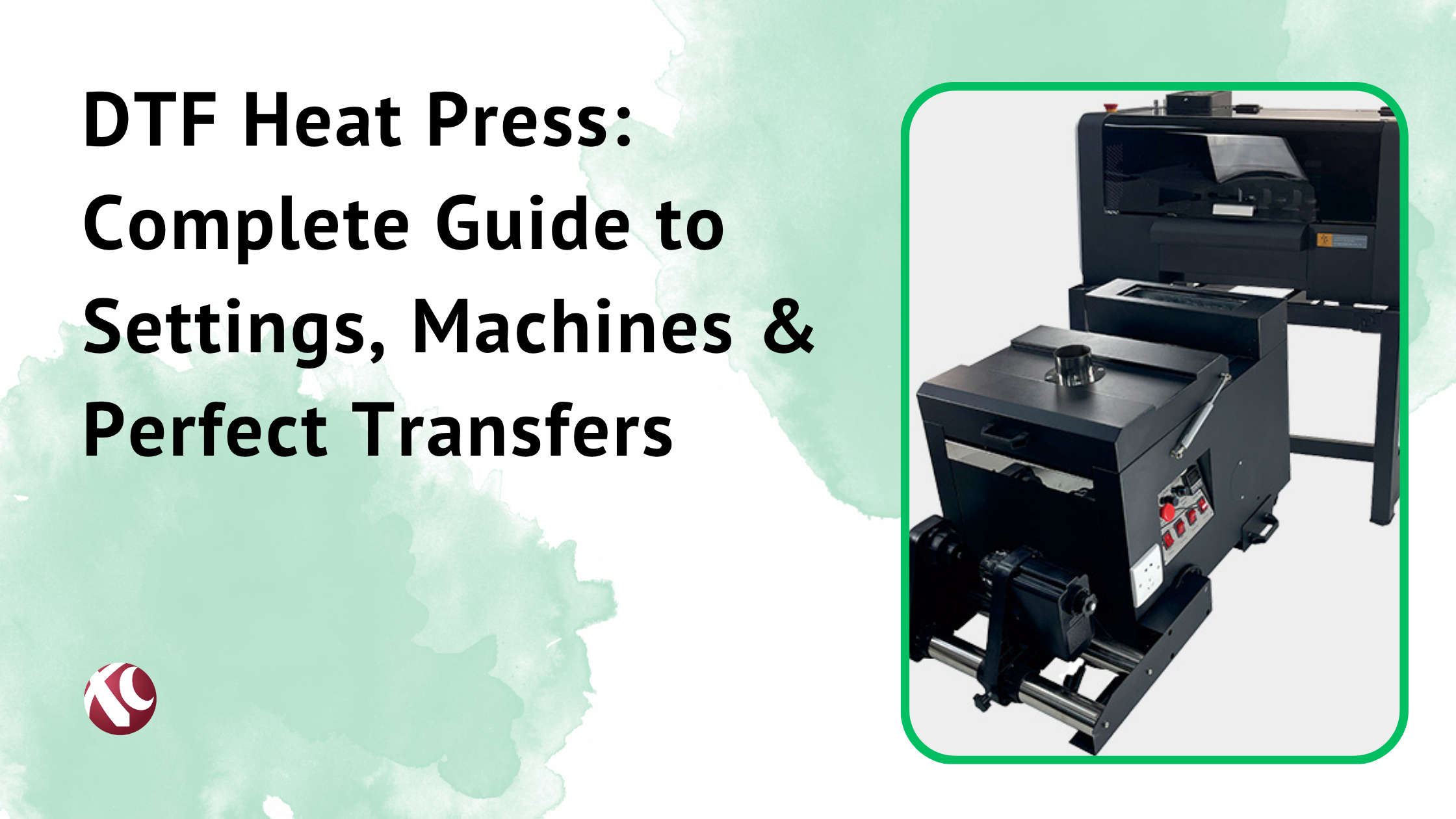
DTF Printer – Not a regular inkjet. These are built specifically for DTF inks and can handle the white ink circulation that prevents clogging. XC Inkjet makes some solid DTF printer options if you’re shopping around.
DTF Inks – CMYK plus White. The white ink is the trickiest part. It settles, it clogs heads if you don’t maintain things. Good ink matters.
PET Film – Special coated film that accepts the ink properly. Comes in sheets or rolls.
Hot Melt Powder – The adhesive that bonds everything to fabric. Different grades for different applications.
Powder Shaker – Applies powder evenly. Some people do it manually, but automated shakers save time and give better results.
Curing Oven – Melts the powder. Can be a separate unit or built into an automated system.
Heat Press – Your transfer station. Quality heat press makes a real difference in consistency.
Advantages of DTF Printing
This is why DTF took off:
- Vibrant colors and excellent detail – Seriously impressive photo-quality prints. Fine text, gradients, complex images all come out clean.
- Works on multiple fabric types – Dark, light, cotton, poly, whatever. One process handles it all.
- No pretreatment required – Unlike DTG printing where you need to spray garments first. DTF skips that step entirely.
- Soft hand feel – The prints are thin enough that they don’t feel plasticky or stiff like some vinyl transfers.
- Cost-effective for small to medium runs – You’re not burning screens. Print one shirt or fifty, the economics work.
- Stretchable and durable prints – The adhesive layer moves with the fabric. Athletic wear, fitted shirts, no problem.
- No weeding required – Unlike vinyl where you’re picking out tiny pieces. The whole design transfers at once.
Disadvantages of DTF Printing
Nothing’s perfect. Here’s the honest truth:
- Requires specific equipment – You can’t just use any printer. DTF needs DTF-specific hardware.
- Initial investment – A decent setup runs a few thousand dollars minimum. More for production-level equipment.
- Learning curve – The powder application takes practice. Too much, too little, uneven coverage—these all cause problems.
- Ongoing material costs – Film, powder, ink. These add up, especially the ink.
- Slightly thicker feel than some methods – It’s not bad. But it’s not as invisible as water-based screen printing on soft tees.
What is UV DTF Printing?
UV DTF is the new kid. And it’s different enough that the “DTF” in the name almost causes more confusion than it’s worth.
UV DTF uses UV-curable inks that dry instantly under UV light. The big difference? No heat press required for application. You just peel and stick.
That opens up a whole world of surfaces that DTF can’t touch.
How Does UV DTF Printing Work?
The process has more steps but the application is dead simple.
Design gets printed onto special UV DTF film using UV-curable inks. Unlike regular DTF, this usually prints the color layer first, then a white backing layer on top.
As each layer prints, UV LED lights cure the ink instantly. It’s dry the second it comes out.
Then a clear protective laminate film gets applied over the print. This gives it that glossy finish and protects the ink layer.
What you end up with is basically a high-quality sticker. Peel off the backing, position it on your surface, press it down by hand or with a roller, peel off the top laminate. Done.
No heat press. No curing. Just stick it and go.
Key Components of UV DTF Printing
Different equipment from standard DTF:
UV DTF Printer – Has built-in UV LED curing system. The ink dries as it prints.
UV-Curable Inks – Completely different chemistry from regular DTF inks. They cure under UV light instead of heat.
UV DTF Film – Two-layer system. The A film receives the print, the B film is the laminate.
UV LED Curing System – Usually integrated into the printer itself.
Lamination Unit – Applies the protective top layer after printing.
The whole system is typically more integrated than standard DTF setups.
Advantages of UV DTF Printing
This is where UV DTF shines:
- No heat press required – Peel and stick. That’s it. Game changer for certain applications.
- Works on hard surfaces – Glass, metal, plastic, wood, acrylic, ceramic, tumblers, phone cases. Surfaces that DTF can’t touch.
- Waterproof and weatherproof – The laminate layer protects everything. Good for outdoor applications.
- High gloss finish – Really polished, professional look. Great for promotional products.
- Quick application – No preheating, no pressing, no waiting. Stick it on and move to the next one.
- No substrate pretreatment – Just clean the surface and apply.
- Excellent for hard surfaces – I’m repeating myself but this is the main selling point. Tumblers alone have made UV DTF huge.
Disadvantages of UV DTF Printing
Here’s where it falls short:
- Higher equipment cost – UV systems are more expensive than standard DTF printers. The technology costs more.
- Limited to smooth surfaces – Textured surfaces don’t work well. The transfer needs full contact to stick properly.
- Thick, raised feel on fabric – It works on fabric technically, but it doesn’t feel good. Stiff, doesn’t stretch well.
- Not ideal for apparel – Seriously, don’t use this for t-shirts. You’ll get complaints.
- Can peel over time – On some surfaces, especially fabrics, the adhesion isn’t permanent.
- Higher per-print cost for some jobs – The materials run more expensive in certain applications.
DTF vs UV DTF: Head-to-Head Comparison

Okay. Let’s put these side by side and see how they actually stack up.
Application Surfaces
This is the fundamental difference.
DTF is built for fabrics. Cotton, polyester, blends, nylon, leather, canvas, denim. If it can take heat press temperature, DTF works. But hard surfaces? Not happening.
UV DTF is built for hard surfaces. Glass, metal, wood, plastic, acrylic, ceramic, tumblers, phone cases, signs, awards. Can it do fabric? Technically yes. Should it? Not really.
If you’re in the apparel business, DTF. If you’re doing promotional products and custom hard goods, UV DTF. Pretty simple.
Print Quality and Durability
Both produce excellent quality. Different durability profiles though.
Color and detail – Both are impressive. UV DTF tends to have that glossy pop. DTF can look more integrated into the fabric.
Wash durability – DTF wins easily. Properly done DTF prints last 50+ washes. UV DTF on fabric starts peeling way sooner.
Scratch resistance – UV DTF is actually better here thanks to the laminate layer.
Outdoor durability – UV DTF takes this one. The weatherproof laminate handles sun, rain, temperature changes.
For fabric longevity, DTF. For hard surface and outdoor durability, UV DTF.
Equipment and Investment Costs
Neither is cheap. But there’s a difference.
UV DTF systems typically cost more upfront. The UV curing technology, the integrated lamination—it adds up. Entry-level is higher.
DTF systems have a lower entry point. You can get started with less capital investment.
Ongoing costs – Both have consumables. Ink, film, powder vs. UV ink, A/B film. DTF materials tend to be a bit cheaper, but it varies.
Maintenance – DTF requires attention to white ink circulation. UV DTF has its own maintenance needs with the UV lamps.
XC Inkjet offers both DTF and UV DTF solutions, which is worth looking into if you’re weighing options. Having one supplier for support makes troubleshooting easier.
Production Speed and Workflow
Different strengths here.
DTF production – Print time is similar to UV DTF. But you add powder application, curing, and heat pressing. Each transfer needs press time.
UV DTF production – Prints come out ready to apply. The application itself takes seconds. No heat press queue.
For high-volume fabric work, DTF workflows can be very efficient with the right setup. For hard goods, UV DTF’s peel-and-stick speed is tough to beat.
Versatility and Flexibility
UV DTF wins on substrate variety – The range of hard surfaces it handles is impressive. One technology, dozens of product types.
DTF wins on fabric types – Dark, light, textured, stretchy. DTF handles fabric variation better than any other single method I know.
If you want to offer 50 different promotional products, UV DTF gives you that. If you want to do any garment someone brings you, DTF gives you that.
Ease of Use and Learning Curve
DTF has a moderate learning curve. The powder application and curing take practice. Heat press settings need dialing in. But it’s forgiving once you learn it.
UV DTF is simpler on the application side. Peel, stick, done. But the printing side has its own quirks with UV inks and maintaining the system.
For absolute beginners, I’d say DTF is actually easier to learn despite the extra steps. The whole process is more visual—you can see what’s happening at each stage.
Transfer Application Method
This matters for business models.
DTF requires a heat press – Fixed location, needs electricity, takes up space. But the bond is strong and permanent on fabric.
UV DTF is peel-and-stick – Apply anywhere. At events, at customer locations, wherever. But on fabric it won’t last like DTF.
If you’re running a shop, the heat press isn’t a big deal. If you’re doing mobile events or have customers apply their own transfers, UV DTF’s simplicity is attractive.
Which Printing Method is Better for Your Business?

Stop looking for a universal answer. There isn’t one.
The right choice depends on what you’re actually going to print, who your customers are, and where your business is heading.
Choose DTF Printing If:
- You’re primarily printing on garments and textiles
- Soft hand feel matters to your customers
- You’re running a custom apparel business—t-shirts, hoodies, bags
- You want cost-effective fabric printing for small to medium runs
- You already have a heat press setup
- Your market is fashion, clothing, uniforms, team wear
- Durability through washing is non-negotiable
DTF is the workhorse for custom apparel right now. If fabric is your focus, this is the technology that makes sense.
Choose UV DTF Printing If:
- You’re printing on hard surfaces—tumblers, signs, glass, awards
- Waterproof and weatherproof matters
- You need application without heat equipment
- Promotional products are your target market
- Outdoor durability is important
- You want to diversify beyond textiles
- Quick turnaround on hard goods is your competitive advantage
UV DTF opened up the custom hard goods market in a way that wasn’t accessible before. If that’s your direction, this is your technology.
Can You Benefit from Both Technologies?
Actually, yes. A lot of businesses do both.
Think about it. Custom apparel AND custom tumblers. T-shirts AND promotional products. Fashion AND corporate gifting.
Having both technologies lets you serve more customer needs. Someone orders team shirts? DTF. They also want branded water bottles for the event? UV DTF. One shop, one customer, multiple products.
Seasonal flexibility helps too. Apparel might be slow in summer while promotional products for outdoor events pick up.
XC Inkjet has solutions covering both technologies, which makes it easier if you’re considering expanding your capabilities.
Frequently Asked Questions
Can UV DTF be used on fabric like regular DTF?
Technically yes. Practically, it’s a bad idea.
UV DTF transfers on fabric feel thick and stiff. They don’t stretch with the material. After a few washes—or sometimes just a few wears—they start cracking and peeling.
The adhesion method just isn’t designed for the movement and stress that fabric goes through. It works fine on a rigid phone case. It fails on a stretchy t-shirt.
If someone asks you to do a shirt with UV DTF, explain why you’re going to use DTF instead. They’ll thank you later.
Is UV DTF printing more expensive than DTF?
Yes and no.
Equipment? UV DTF costs more upfront. The UV curing system adds expense.
Per-print cost? It depends on the application. For fabric printing, DTF is usually cheaper. For hard surfaces, UV DTF is your only real option so the comparison doesn’t really apply.
Material costs vary by volume and supplier. UV DTF film (the A/B combo) tends to run higher than DTF PET film. But you’re eliminating the heat press step, which saves time.
Look at your actual product mix and run the numbers. Generic “which is cheaper” doesn’t mean much without specifics.
Which technology is better for beginners?
I’d say DTF.
The process is more visual. You can see the powder sticking, see it melt when cured, see the transfer happening on the press. Troubleshooting is easier because you can identify where problems occur.
The equipment is more forgiving. If something’s slightly off, you usually still get a usable result.
UV DTF application is simpler—peel and stick is pretty foolproof. But the printing side has UV ink quirks and the system is less forgiving if settings aren’t right.
Start with DTF, learn the fundamentals, then add UV DTF when you want to expand your product range.
Can the same printer do both DTF and UV DTF?
No. Different systems entirely.
DTF printers use aqueous-based inks that need heat and powder for transfer. UV DTF printers use UV-curable inks that dry under UV light. The ink chemistry is completely different. The curing method is completely different.
You can’t just swap inks and switch modes. You need separate equipment.
Some manufacturers offer both types, which is convenient for ordering and support, but they’re still distinct machines.
How long do DTF and UV DTF prints last?
DTF on fabric – Properly done, 50+ washes. Some people report prints lasting the life of the garment. Key factors: quality ink, proper curing, correct heat press settings.
UV DTF on hard surfaces – Years with proper care. The laminate protects against fading and scratching. Outdoor applications hold up through weather and sun exposure.
UV DTF on fabric – Don’t expect much. Maybe a few washes before it starts lifting. Not recommended for anything where durability matters.
Longevity depends on application and substrate. Match the right technology to the right surface and both last a long time.
So which is better? Neither. They’re different tools for different jobs.
If fabric is your game, DTF. If hard surfaces are your market, UV DTF. If you want to do both, well, you probably need both.
Figure out where your business is going, then invest in the technology that gets you there.